
Standing order vs direct debit: what is the difference?
A standing order is a fixed payment you set up; a direct debit lets a company collect what you owe, which can vary. Both repeat, and Statemently lists either as recurring once it has three regular, stable payments.
- No account needed to start
- Free preview of your results
- Checked against printed balances
What Statemently does here
Standing order: you control the amount.
Direct debit: the payee collects.
Both listed as recurring when stable.
A clean, checked export
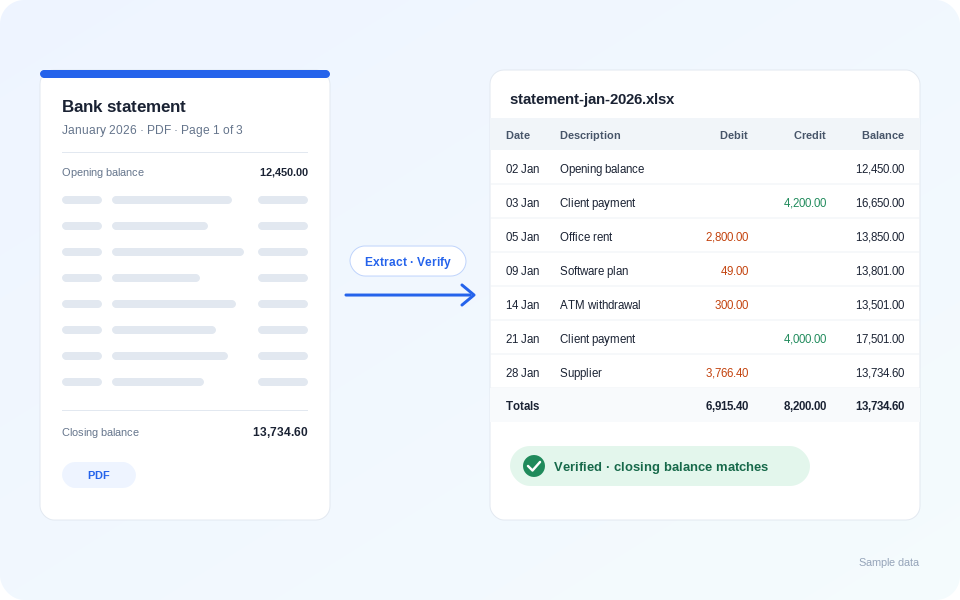
One row per transaction, with debit, credit and running balance in their own columns, and a status for the whole statement. The example below uses sample data.
| Date | Description | Category | Debit | Credit | Balance |
|---|---|---|---|---|---|
| 02 Jan | Opening balance | 12,450.00 | |||
| 03 Jan | Client payment INV-1042 | Income | 4,200.00 | 16,650.00 | |
| 05 Jan | Office rent | Rent | 2,800.00 | 13,850.00 | |
| 09 Jan | Card: software plan | Software | 49.00 | 13,801.00 | |
| 14 Jan | ATM withdrawal | Cash | 300.00 | 13,501.00 | |
| 21 Jan | Client payment INV-1047 | Income | 4,000.00 | 17,501.00 | |
| 28 Jan | Supplier: packaging | Supplies | 3,766.40 | 13,734.60 | |
| Totals | 6,915.40 | 8,200.00 | 13,734.60 | ||
Know the numbers are right before you use them
Opening balance, plus money in, minus money out, must equal the closing balance printed on the statement, and every running balance must follow from the one before. If anything does not add up, you see it.
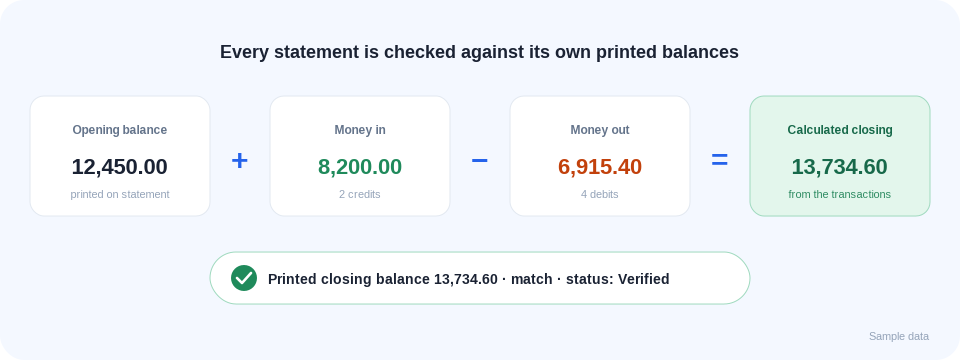
The transactions reconcile with the printed balances and no row needs review.
A check could not be completed, or a row needs a look. You get a list of exactly which.
The printed closing balance contradicts the transactions, so a row is missing or misread.
See the workspace on sample data
Switch the sample, pick a month and open a transaction. It works like the real workspace.
₹84,200 + ₹74,000 − ₹37,520 = ₹1,20,680
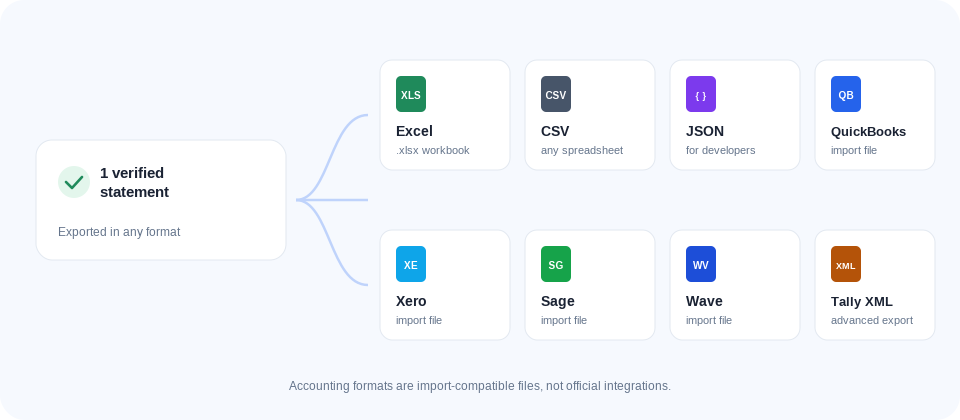
One statement, every format you need
Excel, CSV and JSON are on every plan. Import-compatible files for QuickBooks, Xero, Sage and Wave come with Accounting Pro, and Tally XML and ledger formats with the advanced exports.
From statement to clean data in four steps
- 01
Upload
PDF, scan, phone photo, CSV or XLSX, up to 20 MB. No account needed.
- 02
Extract
Transactions are read into rows, with OCR for scanned pages.
- 03
Verify
The rows are checked against the statement's printed balances.
- 04
Export
Download Excel, CSV, JSON or an accounting import file.
Preview free, subscribe to unlock everything
Every plan includes verification against the statement's printed balances. Cancel anytime.
Professional
Best fit- 100 statements / month
- Up to 100 pages per statement
- OCR for scanned statements & images
Accounting Pro
- 500 statements / month
- Up to 200 pages per statement
- OCR for scanned statements & images
Built for financial documents
Numbers from code, not AI
Totals, balances and verification are calculated by deterministic code. AI only helps read hard scans and phrase answers.
Passwords stay in memory
The password for an encrypted PDF opens the file for that conversion and is never stored.
No bank login, ever
You upload a statement file. Statemently never asks for your online banking credentials.
Frequently asked questions
Why is a direct debit not recurring?
Its amount may vary too much to count as stable.
How do I cancel one?
Through your bank or the payee.
Turn your next statement into checked data
Upload a statement and preview its transactions, charts and verification status in seconds.